

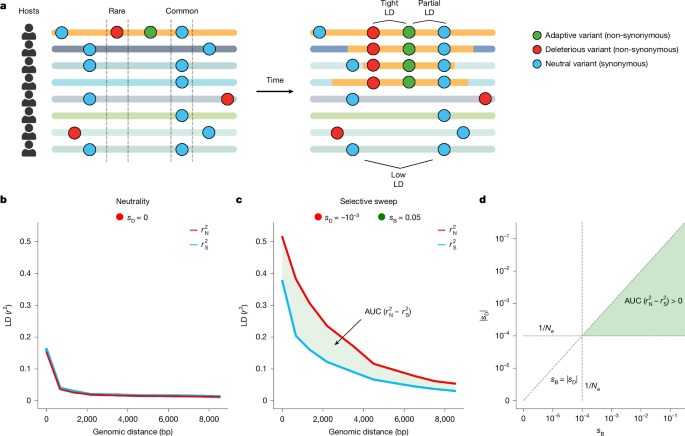
Genespecific, selective, sweeps, pervasive, across, human
Garud, N. R., Good, B. H., Hallatschek, O. & Pollard, K. S. Evolutionary dynamics of bacteria in the gut microbiome within and across hosts. PLoS Biol. 17, e3000102 (2019).
Google Scholar
Zhao, S. et al. Adaptive evolution within gut microbiomes of healthy people. Cell Host Microbe 25, 656–667 (2019).
Google Scholar
Poyet, M. et al. A library of human gut bacterial isolates paired with longitudinal multiomics data enables mechanistic microbiome research. Nat. Med. 25, 1442–1452 (2019).
Google Scholar
Yaffe, E. & Relman, D. A. Tracking microbial evolution in the human gut using hi-c reveals extensive horizontal gene transfer, persistence and adaptation. Nat. Microbiol. 5, 343–353 (2020).
Google Scholar
Zlitni, S. et al. Strain-resolved microbiome sequencing reveals mobile elements that drive bacterial competition on a clinical timescale. Genome Med. 12, 50 (2020).
Google Scholar
Liu, Z. & Good, B. H. Dynamics of bacterial recombination in the human gut microbiome. PLoS Biol. 22, e3002472 (2024).
Google Scholar
Smillie, C. S. et al. Ecology drives a global network of gene exchange connecting the human microbiome. Nature 480, 241–244 (2011).
Google Scholar
Groussin, M. et al. Elevated rates of horizontal gene transfer in the industrialized human microbiome. Cell 184, 2053–2067 (2021).
Google Scholar
McInnes, R. S., McCallum, G. E., Lamberte, L. E. & van Schaik, W. Horizontal transfer of antibiotic resistance genes in the human gut microbiome. Curr. Opin. Microbiol. 53, 35–43 (2020).
Google Scholar
Shapiro, B. J. et al. Population genomics of early events in the ecological differentiation of bacteria. Science 336, 48–51 (2012).
Google Scholar
Shapiro, B. J. & Polz, M. F. Ordering microbial diversity into ecologically and genetically cohesive units. Trends Microbiol. 22, 235–247 (2014).
Google Scholar
Hudson, R. R., Bailey, K., Skarecky, D., Kwiatowski, J. & Ayala, F. J. Evidence for positive selection in the superoxide dismutase (Sod) region of Drosophila melanogaster. Genetics 136, 1329–1340 (1994).
Google Scholar
Vitti, J. J., Grossman, S. R. & Sabeti, P. C. Detecting natural selection in genomic data. Annu. Rev. Genet. 47, 97–120 (2013).
Google Scholar
Sabeti, P. C. et al. Detecting recent positive selection in the human genome from haplotype structure. Nature 419, 832–837 (2002).
Google Scholar
Voight, B. F., Kudaravalli, S., Wen, X. & Pritchard, J. K. A map of recent positive selection in the human genome. PLoS Biol. 4, e72 (2006).
Google Scholar
Garud, N. R., Messer, P. W., Buzbas, E. O. & Petrov, D. A. Recent selective sweeps in North American Drosophila melanogaster show signatures of soft sweeps. PLoS Genet. 11, e1005004 (2015).
Google Scholar
Ferrer-Admetlla, A., Liang, M., Korneliussen, T. & Nielsen, R. On detecting incomplete soft or hard selective sweeps using haplotype structure. Mol. Biol. Evol. 31, 1275–1291 (2014).
Google Scholar
Shapiro, B. J. Signatures of natural selection and ecological differentiation in microbial genomes. Adv. Exp. Med. Biol. 781, 339–359 (2014).
Google Scholar
Good, B. H., Bhatt, A. S. & McDonald, M. J. Unraveling the tempo and mode of horizontal gene transfer in bacteria. Trends Microbiol. 33, 853–865 (2025).
Google Scholar
Pritchard, J. K. & Przeworski, M. Linkage disequilibrium in humans: models and data. Am. J. Hum. Genet. 69, 1–14 (2001).
Google Scholar
Mah, J. C., Lohmueller, K. E. & Garud, N. R. Inference of the demographic histories and selective effects of human gut commensal microbiota over the course of human history. Mol. Biol. Evol. 42, msaf010 (2025).
Google Scholar
Eyre-Walker, A. & Keightley, P. D. The distribution of fitness effects of new mutations. Nat. Rev. Genet. 8, 610–618 (2007).
Google Scholar
Lawrie, D. S. & Petrov, D. A. Comparative population genomics: power and principles for the inference of functionality. Trends Genet. 30, 133–139 (2014).
Google Scholar
Cvijović, I., Good, B. H. & Desai, M. M. The effect of strong purifying selection on genetic diversity. Genetics 209, 1235–1278 (2018).
Google Scholar
Hartfield, M. & Otto, S. P. Recombination and hitchhiking of deleterious alleles. Evolution 65, 2421–2434 (2011).
Google Scholar
Haller, B. C. & Messer, P. W. SLiM 4: Multispecies eco-evolutionary modeling. Am. Nat. 201, E127–E139 (2023).
Google Scholar
Lloyd-Price, J. et al. Strains, functions and dynamics in the expanded human microbiome project. Nature 550, 61–66 (2017).
Google Scholar
Xie, H. et al. Shotgun metagenomics of 250 adult twins reveals genetic and environmental impacts on the gut microbiome. Cell Systems 3, 572–584 (2016).
Google Scholar
Qin, J. et al. A metagenome-wide association study of gut microbiota in type 2 diabetes. Nature 490, 55–60 (2012).
Google Scholar
Korpela, K. et al. Selective maternal seeding and environment shape the human gut microbiome. Genome Res. 28, 561–568 (2018).
Google Scholar
Nayfach, S., Rodriguez-Mueller, B., Garud, N. & Pollard, K. S. An integrated metagenomics pipeline for strain profiling reveals novel patterns of bacterial transmission and biogeography. Genome Res. 26, 1612–1625 (2016).
Google Scholar
Almeida, A. et al. A unified catalog of 204,938 reference genomes from the human gut microbiome. Nat. Biotechnol. 39, 105–114 (2021).
Google Scholar
Shen, E. et al. Subtyping analysis reveals new variants and accelerated evolution of Clostridioides difficile toxin b. Commun. Biol. 3, 347 (2020).
Google Scholar
Mansfield, M. J. et al. Phylogenomics of 8,839 Clostridioides difficile genomes reveals recombination-driven evolution and diversification of toxin A and B. PLoS Pathog. 16, e1009181 (2020).
Google Scholar
Dingle, K. E. et al. Recombinational switching of the Clostridium difficile S-layer and a novel glycosylation gene cluster revealed by large-scale whole-genome sequencing. J. Infect. Dis. 207, 675–686 (2013).
Google Scholar
Steinberg, H. D. & Snitkin, E. S. Homologous recombination in Clostridioides difficile mediates diversification of cell surface features and transport systems. mSphere 5, 10–1128 (2020).
Google Scholar
Chen, D. W. & Garud, N. R. Rapid evolution and strain turnover in the infant gut microbiome. Genome Res. 32, 1124–1136 (2022).
Google Scholar
Tatusov, R. L., Galperin, M. Y., Natale, D. A. & Koonin, E. V. The COG database: a tool for genome-scale analysis of protein functions and evolution. Nucleic Acids Res. 28, 33–36 (2000).
Google Scholar
Barrett, A. J. Enzyme nomenclature. Recommendations 1992: Supplement 2: Corrections and additions (1994). Eur. J. Biochem. 232, 1 (1995).
Google Scholar
Grand, M., Riboulet-Bisson, E., Deutscher, J., Hartke, A. & Sauvageot, N. Enterococcus faecalis maltodextrin gene regulation by combined action of maltose gene regulator MalR and pleiotropic regulator CcpA. Appl. Environ. Microbiol. 86, e01147–20 (2020).
Google Scholar
Arnold, A. R. & Chassaing, B. Maltodextrin, modern stressor of the intestinal environment. Cell. Mol. Gastroenterol. Hepatol. 7, 475–476 (2019).
Google Scholar
Ze, X., Duncan, S. H., Louis, P. & Flint, H. J. Ruminococcus bromii is a keystone species for the degradation of resistant starch in the human colon. ISME J. 6, 1535–1543 (2012).
Google Scholar
Shetty, S. A. et al. Inter-species metabolic interactions in an in-vitro minimal human gut microbiome of core bacteria. NPJ Biofilms Microbiomes 8, 21 (2022).
Google Scholar
Sonnenburg, J. L. & Sonnenburg, E. D. Vulnerability of the industrialized microbiota. Science 366, eaaw9255 (2019).
Google Scholar
Brito, I. L. et al. Mobile genes in the human microbiome are structured from global to individual scales. Nature 535, 435–439 (2016).
Google Scholar
Pasolli, E. et al. Extensive unexplored human microbiome diversity revealed by over 150,000 genomes from metagenomes spanning age, geography, and lifestyle. Cell 176, 649–662 (2019).
Google Scholar
Obregon-Tito, A. J. et al. Subsistence strategies in traditional societies distinguish gut microbiomes. Nat. Commun. 6, 6505 (2015).
Google Scholar
Pehrsson, E. C. et al. Interconnected microbiomes and resistomes in low-income human habitats. Nature 533, 212–216 (2016).
Google Scholar
Liu, W. et al. Unique features of ethnic Mongolian gut microbiome revealed by metagenomic analysis. Sci. Rep. 6, 34826 (2016).
Google Scholar
Rosen, M. J., Davison, M., Bhaya, D. & Fisher, D. S. Fine-scale diversity and extensive recombination in a quasisexual bacterial population occupying a broad niche. Science 348, 1019–1023 (2015).
Google Scholar
Sakoparnig, T., Field, C. & van Nimwegen, E. Whole genome phylogenies reflect the distributions of recombination rates for many bacterial species. eLife 10, e65366 (2021).
Google Scholar
Hehemann, J.-H. et al. Transfer of carbohydrate-active enzymes from marine bacteria to Japanese gut microbiota. Nature 464, 908–912 (2010).
Google Scholar
Tourrette, E. et al. An ancient ecospecies of Helicobacter pylori. Nature 635, 178–185 (2024).
Google Scholar
Stolyarova, A. V. et al. Complex fitness landscape shapes variation in a hyperpolymorphic species. eLife 11, e76073 (2022).
Google Scholar
Arnold, B. et al. Fine-scale haplotype structure reveals strong signatures of positive selection in a recombining bacterial pathogen. Mol. Biol. Evol. 37, 417–428 (2020).
Google Scholar
Crits-Christoph, A., Olm, M. R., Diamond, S., Bouma-Gregson, K. & Banfield, J. F. Soil bacterial populations are shaped by recombination and gene-specific selection across a grassland meadow. ISME J. 14, 1834–1846 (2020).
Google Scholar
Callahan, B., Neher, R. A., Bachtrog, D., Andolfatto, P. & Shraiman, B. I. Correlated evolution of nearby residues in drosophilid proteins. PLoS Genet. 7, e1001315 (2011).
Google Scholar
Rocha, E. P. & Feil, E. J. Mutational patterns cannot explain genome composition: Are there any neutral sites in the genomes of bacteria?. PLoS Genet. 6, e1001104 (2010).
Google Scholar
Schloissnig, S. et al. Genomic variation landscape of the human gut microbiome. Nature 493, 45–50 (2013).
Google Scholar
Assaf, Z. J., Petrov, D. A. & Blundell, J. R. Obstruction of adaptation in diploids by recessive, strongly deleterious alleles. Proc. Natl Acad. Sci. USA 112, E2658–E2666 (2015).
Google Scholar
Arevalo, P., VanInsberghe, D., Elsherbini, J., Gore, J. & Polz, M. F. A reverse ecology approach based on a biological definition of microbial populations. Cell 178, 820–834 (2019).
Google Scholar
Liu, B., Zheng, D., Zhou, S., Chen, L. & Yang, J. VFDB 2022: a general classification scheme for bacterial virulence factors. Nucleic Acids Res. 50, D912–D917 (2022).
Google Scholar
Lack, J. B. et al. The Drosophila Genome Nexus: a population genomic resource of 623 Drosophila melanogaster genomes, including 197 from a single ancestral range population. Genetics 199, 1229–1241 (2015).
Wolff, R. & Garud, N. Gene-specific selective sweeps are pervasive across human gut microbiomes. Dryad https://datadryad.org/dataset/doi:10.5061/dryad.9ghx3ffx4 (2025).
Wolff, R. & Garud, N. Gene-specific selective sweeps are pervasive across human gut microbiomes. Zenodo https://doi.org/10.5281/zenodo.17253586 (2025).
Gangwer, K. A. et al. Molecular evolution of the Helicobacter pylori vacuolating toxin gene vacA. J. Bacteriol. 192, 6126–6135 (2010).
Google Scholar
■ مصدر الخبر الأصلي
نشر لأول مرة على: www.nature.com
تاريخ النشر: 2025-12-17 02:00:00
الكاتب: Richard Wolff
تنويه من موقع “yalebnan.org”:
تم جلب هذا المحتوى بشكل آلي من المصدر:
www.nature.com
بتاريخ: 2025-12-17 02:00:00.
الآراء والمعلومات الواردة في هذا المقال لا تعبر بالضرورة عن رأي موقع “yalebnan.org”، والمسؤولية الكاملة تقع على عاتق المصدر الأصلي.
ملاحظة: قد يتم استخدام الترجمة الآلية في بعض الأحيان لتوفير هذا المحتوى.