
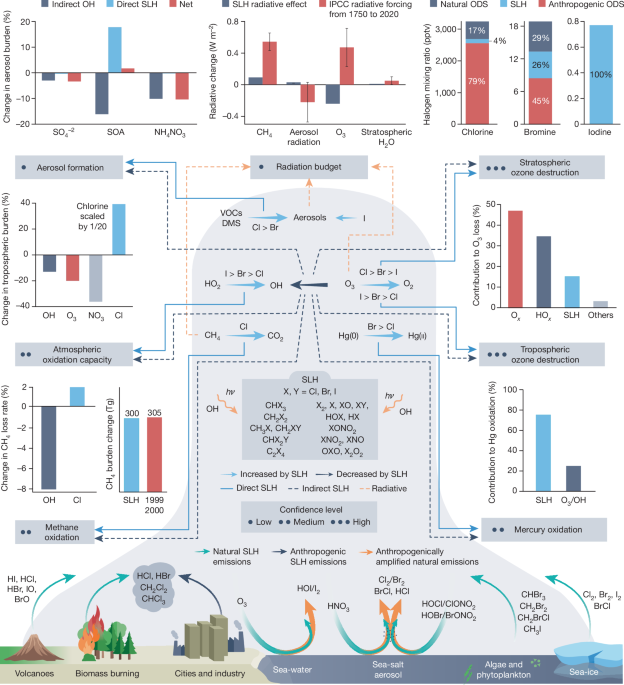
influence of sholived halogens on atmospheric chemistry and climate
Molina, M. J. & Rowland, F. S. Stratospheric sink for chlorofluoromethanes—chlorine atomic-catalysed destruction of ozone. Nature 249, 810–812 (1974).
Google Scholar
Wofsy, C., Mcelroy, M. B. & Yung, Y. L. The chemistry of atmospheric bromine. Geophys. Res. Lett. 2, 215–218 (1975).
Google Scholar
McElroy, M. B., Salawitch, R. J., Wofsy, S. C. & Logan, J. A. Reductions of Antarctic ozone due to synergistic interactions of chlorine and bromine. Nature 321, 759–762 (1986). Antarctic stratospheric ozone loss was attributed to synergistic chemical reactions between chlorine and bromine compounds.
Google Scholar
Scientific Assessment of Ozone Depletion: 2022 (WMO, 2022); library.wmo.int/idurl/4/58360.
Yung, Y. L., Mcelroy, M. B. & Wofsy, S. C. Atmospheric halocarbons: a discussion with emphasis on chloroform. Geophys. Res. Lett. 2, 397–399 (1975).
Google Scholar
Dorf, M. et al. Bromine in the tropical troposphere and stratosphere as derived from balloon-borne BrO observations. Atmos. Chem. Phys. 8, 7265–7271 (2008).
Google Scholar
Salawitch, R. J. et al. A new interpretation of total column BrO during Arctic spring. Geophys. Res. Lett. 37, L21805 (2010).
Google Scholar
Koenig, T. K. et al. Quantitative detection of iodine in the stratosphere. Proc. Natl Acad. Sci. USA https://doi.org/10.1073/pnas.1916828117 (2020). First direct observations of reactive iodine compounds in the stratosphere.
Textor, C., Graf, H. F., Herzog, M. & Oberhuber, J. M. Injection of gases into the stratosphere by explosive volcanic eruptions. J. Geophys. Res. Atmos. 108, 4606 (2003).
Google Scholar
Sturges, W. T., Oram, D. E., Carpenter, L. J., Penkett, S. A. & Engel, A. Bromoform as a source of stratospheric bromine. Geophys. Res. Lett. 27, 2081–2084 (2000). The study showed that bromine-containing SLHs can contribute to stratospheric ozone depletion.
Google Scholar
Saiz-Lopez, A. et al. Injection of iodine to the stratosphere. Geophys. Res. Lett. 42, 6852–6859 (2015).
Google Scholar
Fernandez, R. P., Salawitch, R. J., Kinnison, D. E., Lamarque, J.-F. & Saiz-Lopez, A. Bromine partitioning in the tropical tropopause layer: implications for stratospheric injection. Atmos. Chem. Phys. 14, 13391–13410 (2014).
Google Scholar
Salawitch, R. J. Sensitivity of ozone to bromine in the lower stratosphere. Geophys. Res. Lett. 32, L05811 (2005).
Google Scholar
Kovalenko, L. J. et al. Validation of aura microwave limb sounder BrO observations in the stratosphere. J. Geophys. Res. Atmos. 112, D24S41 (2007).
Google Scholar
Fu, X. et al. Anthropogenic short-lived halogens increase human exposure to mercury contamination due to enhanced mercury oxidation over continents. Proc. Natl Acad. Sci. USA 121, e2315058121 (2024).
Google Scholar
Sinnhuber, B.-M. Global observations of stratospheric bromine monoxide from SCIAMACHY. Geophys. Res. Lett. 32, L20810 (2005).
Google Scholar
Solomon, S., Garcia, R. R. & Ravishankara, A. R. On the role of iodine in ozone depletion. J. Geophys. Res. 99, 20491 (1994). This work hypothesised the importance of iodine-containing compounds in the depletion of stratospheric ozone.
Google Scholar
Butz, A. et al. Constraints on inorganic gaseous iodine in the tropical upper troposphere and stratosphere inferred from balloon-borne solar occultation observations. Atmos. Chem. Phys. 9, 7229–7242 (2009).
Google Scholar
Pundt, I., Pommereau, J. P. J.-P. P., Phillips, C. & Lateltin, E. Upper limit of iodine oxide in the lower stratosphere. J. Atmos. Chem. 30, 173–185 (1998).
Google Scholar
Sinnhuber, B. M., Sheode, N., Sinnhuber, M., Chipperfield, M. P. & Feng, W. The contribution of anthropogenic bromine emissions to past stratospheric ozone trends: a modelling study. Atmos. Chem. Phys. 9, 2863–2871 (2009).
Google Scholar
Cuevas, C. A. et al. The influence of iodine on the Antarctic stratospheric ozone hole. Proc. Natl Acad. Sci. USA 119, e2110864119 (2022).
Google Scholar
Fernandez, R. P., Kinnison, D. E., Lamarque, J. F., Tilmes, S. & Saiz-Lopez, A. Impact of biogenic very short-lived bromine on the Antarctic ozone hole during the 21st century. Atmos. Chem. Phys. 17, 1673–1688 (2017).
Google Scholar
Oman, L. D. et al. The effect of representing bromine from VSLS on the simulation and evolution of Antarctic ozone. Geophys. Res. Lett. 43, 9869–9876 (2016).
Google Scholar
Villamayor, J. et al. Very short-lived halogens amplify ozone depletion trends in the tropical lower stratosphere. Nat. Clim. Change 13, 554–560 (2023).
Google Scholar
Bureau, H. et al. Modern and past volcanic degassing of iodine. Geochim. Cosmochim. Acta 173, 114–125 (2016).
Google Scholar
Østerstrøm, F. F., Klobas, J. E., Kennedy, R. P., Cadoux, A. & Wilmouth, D. M. Sensitivity of stratospheric ozone to the latitude, season, and halogen content of a contemporary explosive volcanic eruption. Sci. Rep. 13, 6457 (2023).
Google Scholar
Tilmes, S. et al. Impact of very short-lived halogens on stratospheric ozone abundance and UV radiation in a geo-engineered atmosphere. Atmos. Chem. Phys. 12, 10945–10955 (2012).
Google Scholar
Barrie, L. A., Bottenheim, J. W., Schnell, R. C., Crutzen, P. J. & Rasmussen, R. A. Ozone destruction and photochemical reactions at polar sunrise in the lower Arctic atmosphere. Nature 334, 138–141 (1988). First ODEs observed in the lower troposphere, bromine-containing SLHs were identified as the main driver of this destruction.
Google Scholar
Finlayson-Pitts, B. J., Livingston, F. E. & Berko, H. N. Ozone destruction and bromine photochemistry at ground-level in the arctic spring. Nature 343, 622–625 (1990).
Google Scholar
Fan, S. M. & Jacob, D. J. Surface ozone depletion in arctic spring sustained by bromine reactions on aerosols. Nature 359, 522–524 (1992).
Google Scholar
McConnell, J. C. et al. Photochemical bromine production implicated in arctic boundary layer ozone depletion. Nature 355, 150–152 (1992).
Google Scholar
Kreher, K., Johnston, P. V., Wood, S. W., Nardi, B. & Platt, U. Ground-based measurements of tropospheric and stratospheric BrO at Arrival Heights, Antarctica. Geophys. Res. Lett. 24, 3021–3024 (1997).
Google Scholar
Wagner, T. & Platt, U. Satellite mapping of enhanced BrO concentrations in the troposphere. Nature 395, 486–490 (1998). Satellite-based observations of bromine-containing SLHs reported in this study have enabled an improved understanding of their geographical distribution.
Google Scholar
Saiz-Lopez, A. & von Glasow, R. Reactive halogen chemistry in the troposphere. Chem. Soc. Rev. https://doi.org/10.1039/c2cs35208g (2012).
Google Scholar
von Glasow, R. et al. Impact of reactive bromine chemistry in the troposphere. Atmos. Chem. Phys. 4, 2481–2497 (2004).
Google Scholar
Yang, M. et al. Tropospheric bromine chemistry and its impacts on ozone: a model study. J. Geophys. Res. Atmos. 110, D23311 (2005).
Wang, S. et al. Direct detection of atmospheric atomic bromine leading to mercury and ozone depletion. Proc. Natl Acad. Sci. USA 116, 14479–14484 (2019).
Google Scholar
Pratt, K. A. et al. Photochemical production of molecular bromine in Arctic surface snowpacks. Nat. Geosci. 6, 351–356 (2013).
Google Scholar
Simpson, W. R., Brown, S. S., Saiz-Lopez, A., Thornton, J. A. & Von Glasow, R. Tropospheric halogen chemistry: sources, cycling, and impacts. Chem. Rev. https://doi.org/10.1021/cr5006638 (2015).
Richter, A., Wittrock, F., Eisinger, M. & Burrows, J. P. GOME observations of tropospheric BrO in northern hemispheric spring and summer 1997. Geophys. Res. Lett. 25, 2683–2686 (1998).
Google Scholar
Chance, K. Analysis of BrO measurements from the global ozone monitoring experiment. Geophys. Res. Lett. 25, 3335–3338 (1998).
Google Scholar
Saiz-Lopez, A. et al. Boundary layer halogens in coastal Antarctica. Science 317, 348–351 (2007). This study first showed that iodine-containing SLHs can contribute to ozone destruction in the polar regions and enhance the effect of bromine compounds.
Google Scholar
Benavent, N. et al. Substantial contribution of iodine to Arctic ozone destruction. Nat. Geosci. 15, 770–773 (2022).
Google Scholar
Mahajan, A. S. et al. Evidence of reactive iodine chemistry in the Arctic boundary layer. J. Geophys. Res. 115, D20 (2010).
Raso, A. R. W. et al. Active molecular iodine photochemistry in the Arctic. Proc. Natl Acad. Sci. USA 114, 10053–10058 (2017).
Google Scholar
Schönhardt, A. et al. Observations of iodine monoxide columns from satellite. Atmos. Chem. Phys. 8, 637–653 (2008).
Google Scholar
Saiz-Lopez, A., Chance, K. V., Liu, X., Kurosu, T. P. & Sander, S. P. First observations of iodine oxide from space. Geophys. Res. Lett. 34, L12812 (2007).
Google Scholar
Mahajan, A. S. et al. Differences in iodine chemistry over the Antarctic continent. Polar Sci. https://doi.org/10.1016/j.polar.2023.101014 (2023).
Saiz-Lopez, A. & Blaszczak-Boxe, C. S. The polar iodine paradox. Atmos. Environ. 145, 72–73 (2016).
Google Scholar
Baccarini, A. et al. Frequent new particle formation over the high Arctic pack ice by enhanced iodine emissions. Nat. Commun. 11, 4924 (2020).
Google Scholar
Sipilä, M. et al. Molecular-scale evidence of aerosol particle formation via sequential addition of HIO3. Nature 537, 532–534 (2016).
Google Scholar
Liao, J. et al. High levels of molecular chlorine in the Arctic atmosphere. Nat. Geosci. 7, 91–94 (2014).
Google Scholar
Abbatt, J. P. D. et al. Halogen activation via interactions with environmental ice and snow in the polar lower troposphere and other regions. Atmos. Chem. Phys. 12, 6237–6271 (2012).
Google Scholar
Buys, Z. et al. High temporal resolution Br2, BrCl and BrO observations in coastal Antarctica. Atmos. Chem. Phys. 13, 1329–1343 (2013).
Google Scholar
Foster, K. L. et al. The Role of Br2 and BrCl in surface ozone destruction at Polar sunrise. Science 291, 471–474 (2001).
Google Scholar
Roberts, J. M. et al. Observations of cyanogen bromide (BrCN) in the global troposphere and their relation to polar surface O3 destruction. Atmos. Chem. Phys. 24, 3421–3443 (2024).
Google Scholar
Fernandez, R. P. et al. Arctic halogens reduce ozone in the northern mid-latitudes. Proc. Natl Acad. Sci. USA 121, e2401975121 (2024).
Chameides, W. L. & Davis, D. D. Iodine: its possible role in tropospheric photochemistry. J. Geophys. Res. 85, 7383–7398 (1980). This was the first study to show that iodine-containing SLHs can be emitted directly from the ocean surface, suggesting a global source.
Google Scholar
Garland, J. A. & Curtis, H. Emission of iodine from the sea surface in the presence of ozone. J. Geophys. Res. 86, 3183–3186 (1981).
Google Scholar
Read, K. A. et al. Extensive halogen-mediated ozone destruction over the tropical Atlantic Ocean. Nature 453, 1232–1235 (2008). Observations of iodine- and bromine-containing SLHs showed that SLH are the most important sink of ozone in the remote marine boundary layer after photolysis.
Google Scholar
Mahajan, A. S. et al. Measurement and modelling of tropospheric reactive halogen species over the tropical Atlantic Ocean. Atmos. Chem. Phys. 10, 4611–4624 (2010).
Google Scholar
Mahajan, A. S. et al. Latitudinal distribution of reactive iodine in the Eastern Pacific and its link to open ocean sources. Atmos. Chem. Phys. 12, 11609–11617 (2012).
Google Scholar
Prados-Roman, C. et al. Iodine oxide in the global marine boundary layer. Atmos. Chem. Phys. 15, 583–593 (2015).
Google Scholar
Saiz-Lopez, A. et al. Estimating the climate significance of halogen-driven ozone loss in the tropical marine troposphere. Atmos. Chem. Phys. 12, 3939–3949 (2012).
Google Scholar
Dix, B. et al. Detection of iodine monoxide in the tropical free troposphere. Proc. Natl Acad. Sci. USA 110, 2035–2040 (2013).
Google Scholar
Großmann, K. et al. Iodine monoxide in the Western Pacific marine boundary layer. Atmos. Chem. Phys. 13, 3363–3378 (2013).
Google Scholar
Leser, H., Honninger, G. & Platt, U. MAX-DOAS measurements of BrO and NO2 in the marine boundary layer. Geophys. Res. Lett. 30, 1537 (2003).
Google Scholar
Mahajan, A. S. et al. Understanding iodine chemistry over the northern and equatorial Indian Ocean. J. Geophys. Res. Atmos. https://doi.org/10.1029/2018JD029063 (2019).
van Herpen, M. M. J. W. et al. Photocatalytic chlorine atom production on mineral dust–sea spray aerosols over the North Atlantic. Proc. Natl Acad. Sci. USA 120, e2303974120 (2023). This study showed that heterogeneous reactions on dust and sea spray are a major source of chlorine-containing SLHs.
Google Scholar
Salawitch, R. J. Biogenic bromine. Nature 439, 275–277 (2006). This study highlighted that biogenic sources of bromine also contribute to tropospheric ozone reduction and may therefore be linked to climate change.
Google Scholar
Badia, A. et al. Importance of reactive halogens in the tropical marine atmosphere: A regional modelling study using WRF-Chem. Atmos. Chem. Phys. 19, 3161–3189 (2019).
Google Scholar
Mahajan, A. S. et al. Modelling the impacts of iodine chemistry on the Northern Indian Ocean marine boundary layer. Atmos. Chem. Phys. https://doi.org/10.5194/acp-2020-1219 (2021).
Li, Q. et al. Impact of halogen chemistry on summertime air quality in coastal and continental Europe: application of the CMAQ model and implications for regulation. Atmos. Chem. Phys. 19, 15321–15337 (2019).
Google Scholar
Sherwen, T. et al. Global impacts of tropospheric halogens (Cl, Br, I) on oxidants and composition in GEOS-Chem. Atmos. Chem. Phys. 16, 12239–12271 (2016).
Google Scholar
Ordóñez, C. et al. Bromine and iodine chemistry in a global chemistry-climate model: description and evaluation of very short-lived oceanic sources. Atmos. Chem. Phys. 12, 1423–1447 (2012).
Google Scholar
Sherwen, T. et al. Iodine’s impact on tropospheric oxidants: a global model study in GEOS-Chem. Atmos. Chem. Phys. 16, 1161–1186 (2016).
Google Scholar
Hossaini, R. et al. A global model of tropospheric chlorine chemistry: organic versus inorganic sources and impact on methane oxidation. J. Geophys. Res. 121, 14271–14297 (2016).
Google Scholar
Iglesias-Suarez, F. et al. Natural halogens buffer tropospheric ozone in a changing climate. Nat. Clim. Change 10, 147–154 (2020).
Google Scholar
Saiz-Lopez, A. et al. Iodine chemistry in the troposphere and its effect on ozone. Atmos. Chem. Phys. 14, 13119–13143 (2014).
Google Scholar
Fernandez, R. P. et al. Intercomparison between surrogate, explicit, and full treatments of vsl bromine chemistry within the CAM-Chem chemistry-climate model. Geophys. Res. Lett. 48, e2020GL091125 (2021).
Google Scholar
Badia, A. et al. The role of natural halogens in global tropospheric ozone chemistry and budget under different 21st century climate scenarios. J. Geophys. Res. Atmos. 126, e2021JD034859 (2021).
Google Scholar
Bossolasco, A. et al. Key role of short-lived halogens on global atmospheric oxidation during historical periods. Environ. Sci. Atmos. https://doi.org/10.1039/D4EA00141A (2025).
Google Scholar
Li, Q. et al. Reactive halogens increase the global methane lifetime and radiative forcing in the 21st century. Nat. Commun. 13, 2768 (2022). This study showed that SLHs affect the lifetime of methane and therefore have an indirect effect on radiative forcing.
Google Scholar
Saiz-Lopez, A. et al. Natural short-lived halogens exert an indirect cooling effect on climate. Nature 618, 967–973 (2023). This study showed that SLHs affect climate and that this effect is changing over time due to changes in emissions.
Google Scholar
Finlayson-Pitts, B. J., Ezell, M. J. & Pitts, J. N. Formation of chemically active chlorine compounds by reactions of atmospheric NaCl particles with gaseous N2O5 and ClONO2. Nature 337, 241–244 (1989). This study showed that heterogeneous reactions in polluted environments can lead to the emission of SLHs from sea salt particles, suggesting a feedback between air quality and SLHs.
Google Scholar
Schroeder, W. H. & Drone, P. Formation of nitrosyl chloride from salt particles in air. Environ. Sci. Technol. 8, 756–758 (1974).
Google Scholar
Spicer, C. W. et al. Unexpectedly high concentrations of molecular chlorine in coastal air. Nature 394, 353–356 (1998). This study showed the presence of high levels of chlorine-containing SLHs in polluted environments.
Google Scholar
Osthoff, H. D. et al. High levels of nitryl chloride in the polluted subtropical marine boundary layer. Nat. Geosci. 1, 324–328 (2008).
Google Scholar
Alicke, B., Hebestreit, K., Stutz, J. & Platt, U. Iodine oxide in the marine boundary layer. Nature 397, 572–573 (1999).
Google Scholar
O’Dowd, C. D. et al. Marine aerosol formation from biogenic iodine emissions. Nature 417, 632–636 (2002). This study showed that iodine-containing SLHs can lead to new particle formation, acting as a source of aerosols.
Google Scholar
Saiz-Lopez, A. & Plane, J. M. C. Novel iodine chemistry in the marine boundary layer. Geophys. Res. Lett. 31, L04112 (2004).
Google Scholar
McFiggans, G. B. Marine aerosols and iodine emissions. Nature 433, E13 (2005).
Google Scholar
Thornton, J. A. et al. A large atomic chlorine source inferred from mid-continental reactive nitrogen chemistry. Nature 464, 271–274 (2010). This study showed that chlorine chemistry is highly active even in polluted continental environments far from marine sources.
Google Scholar
Li, Q. et al. Halogens enhance haze pollution in China. Environ. Sci. Technol. 55, 13625–13637 (2021).
Google Scholar
Wang, T. et al. Observations of nitryl chloride and modeling its source and effect on ozone in the planetary boundary layer of southern China. J. Geophys. Res. Atmos. 121, 2476–2489 (2016).
Google Scholar
Brown, S. S. & Stutz, J. Nighttime radical observations and chemistry. Chem. Soc. Rev. 41, 6405–6447 (2012).
Google Scholar
Saiz-Lopez, A. et al. Nighttime atmospheric chemistry of iodine. Atmos. Chem. Phys. 16, 15593–15604 (2016).
Google Scholar
Hebestreit, K. et al. DOAS measurements of tropospheric bromine oxide in mid-latitudes. Science 283, 55–57 (1999).
Google Scholar
Stutz, J., Ackermann, R., Fast, J. D. & Barrie, L. A. Atmospheric reactive chlorine and bromine at the Great Salt Lake, Utah. Geophys. Res. Lett. 29, 1380 (2002).
Google Scholar
Zingler, J. & Platt, U. Iodine oxide in the Dead Sea Valley: evidence for inorganic sources of boundary layer IO. J. Geophys. Res. Atmos. 110, D07307 (2005).
Google Scholar
Bobrowski, N., Hönninger, G. H., Galle, B. & Platt, U. Detection of bromine monoxide in a volcanic plume. Nature 423, 273–276 (2003).
Google Scholar
Claxton, T. et al. A synthesis inversion to constrain global emissions of two very short lived chlorocarbons: dichloromethane, and perchloroethylene. J. Geophys. Res. Atmos. 125, e2019JD031818 (2020).
Google Scholar
An, M. et al. Rapid increase in dichloromethane emissions from China inferred through atmospheric observations. Nat. Commun. 12, 7279 (2021). New emissions of chlorine-containing SLH were identified in this study, showing that anthropogenic activities are a direct source of SLH.
Google Scholar
Fang, X. et al. Rapid increase in ozone-depleting chloroform emissions from China. Nat. Geosci. 12, 89–93 (2019).
Google Scholar
Hossaini, R. et al. Growth in stratospheric chlorine from short-lived chemicals. Geophys. Res. Lett. 42, 4573–4580 (2015).
Google Scholar
Hossaini, R. et al. The contribution of natural and anthropogenic very short-lived species to stratospheric bromine. Atmos. Chem. Phys. 12, 371–380 (2012).
Google Scholar
Peng, X. et al. An unexpected large continental source of reactive bromine and chlorine with significant impact on wintertime air quality. Natl Sci. Rev. 8, nwaa304 (2021).
Tsai, C. et al. Nocturnal loss of NOx during the 2010 CalNex-LA study in the Los Angeles Basin. J. Geophys. Res. Atmos. 119, 13004–13025 (2014).
Google Scholar
Sarwar, G., Simon, H., Xing, J. & Mathur, R. Importance of tropospheric ClNO2 chemistry across the Northern Hemisphere. Geophys. Res. Lett. 41, 4050–4058 (2014).
Google Scholar
Bannan, T. J. et al. The first UK measurements of nitryl chloride using a chemical ionizationmass spectrometer in central London in the summer of 2012, and an investigation of the role of Cl atom oxidation. J. Geophys. Res. Atmos. 120, 5638–5657 (2015).
Google Scholar
Baker, A. K. et al. Evidence for strong, widespread chlorine radical chemistry associated with pollution outflow from continental Asia. Sci. Rep. 6, 36821 (2016).
Google Scholar
Riedel, T. P. et al. Chlorine activation within urban or power plant plumes: vertically resolved ClNO2 and Cl2 measurements from a tall tower in a polluted continental setting. J. Geophys. Res. https://doi.org/10.1002/jgrd.50637 (2013).
Google Scholar
Gunthe, S. S. et al. Enhanced aerosol particle growth sustained by high continental chlorine emission in India. Nat. Geosci. https://doi.org/10.1038/s41561-020-00677-x (2021).
Google Scholar
Li, Q. et al. Chemical interactions between ship-originated air pollutants and ocean-emitted halogens. J. Geophys. Res. Atmos. 126, e2020JD034175 (2021).
Womack, C. C. et al. Midlatitude ozone depletion and air quality impacts from industrial halogen emissions in the Great Salt Lake basin. Environ. Sci. Technol. 57, 1870–1881 (2023).
Google Scholar
McNamara, S. M. et al. Observation of N2O5 deposition and ClNO2 production on the saline snowpack. ACS Earth Sp. Chem. 5, 1020–1031 (2021).
Google Scholar
Young, C. J. et al. Chlorine as a primary radical: evaluation of methods to understand its role in initiation of oxidative cycles. Atmos. Chem. Phys. 14, 3427–3440 (2014).
Google Scholar
Decker, Z. C. J. et al. Airborne observations constrain heterogeneous nitrogen and halogen chemistry on tropospheric and stratospheric biomass burning aerosol. Geophys. Res. Lett. 51, e2023GL107273 (2024).
Google Scholar
Solomon, S. et al. Chlorine activation and enhanced ozone depletion induced by wildfire aerosol. Nature 615, 259–264 (2023). This study showed that the injection of organic aerosols from wildfires can lead to the activation of reactive chlorine species in the stratosphere.
Google Scholar
Lobert, J. M., Keene, W. C., Logan, J. A. & Yevich, R. Global chlorine emissions from biomass burning: reactive chlorine emissions inventory. J. Geophys. Res. Atmos. 104, 8373–8389 (1999).
Google Scholar
Peng, X. et al. Photodissociation of particulate nitrate as a source of daytime tropospheric Cl2. Nat. Commun. 13, 939 (2022).
Google Scholar
Xia, M. et al. Pollution-derived Br2 boosts oxidation power of the coastal atmosphere. Environ. Sci. Technol. 56, 12055–12065 (2022).
Google Scholar
Shah, V. et al. Improved mechanistic model of the atmospheric redox chemistry of mercury. Environ. Sci. Technol. https://doi.org/10.1021/acs.est.1c03160 (2021).
Google Scholar
Schroeder, W. H. et al. Arctic springtime depletion of mercury. Nature 394, 331–332 (1998).
Google Scholar
Saiz-Lopez, A. et al. The chemistry of mercury in the stratosphere. Geophys. Res. Lett. 49, e2022GL097953 (2022).
IPCC. Climate Change 2021: The Physical Science Basis. Contribution of Working Group I to the Sixth Assessment Report of the Intergovernmental Panel on Climate Change (eds Masson-Delmotte, V. et al.) (Cambridge Univ. Press, 2021).
Hossaini, R. et al. Efficiency of short-lived halogens at influencing climate through depletion of stratospheric ozone. Nat. Geosci. 8, 186–190 (2015).
Google Scholar
Kok, J. F. et al. Mineral dust aerosol impacts on global climate and climate change. Nat. Rev. Earth Environ. 4, 71–86 (2023).
Google Scholar
Thornhill, G. D., Smith, L. A. & Shine, K. P. Radiative forcing from halogen reservoir and halocarbon breakdown products. J. Geophys. Res. Atmos. 129, e2024JD040912 (2024).
Cuevas, C. A. et al. Rapid increase in atmospheric iodine levels in the North Atlantic since the mid-20th century. Nat. Commun. 9, 1452 (2018). First ice core iodine observations showed that atmospheric iodine levels have significantly increased since pre-industrial times.
Google Scholar
Legrand, M. et al. Alpine ice evidence of a three-fold increase in atmospheric iodine deposition since 1950 in Europe due to increasing oceanic emissions. Proc. Natl Acad. Sci. USA 115, 12136–12141 (2018).
Google Scholar
Zhao, X., Hou, X. & Zhou, W. Atmospheric iodine (127I and 129I) record in spruce tree rings in the northeast Qinghai-Tibet Plateau. Environ. Sci. Technol. 53, 8706–8714 (2019).
Google Scholar
Carpenter, L. J. et al. Atmospheric iodine levels influenced by sea surface emissions of inorganic iodine. Nat. Geosci. 6, 108–111 (2013). This laboratory study provided a parameterisation for the emission of iodine-containing SLHs from the ocean surface, enabling modelling the global atmospheric impacts of these compounds.
Google Scholar
MacDonald, S. M. et al. A laboratory characterisation of inorganic iodine emissions from the sea surface: dependence on oceanic variables and parameterisation for global modelling. Atmos. Chem. Phys. 14, 5841–5852 (2014).
Google Scholar
Prados-Roman, C. et al. A negative feedback between anthropogenic ozone pollution and enhanced ocean emissions of iodine. Atmos. Chem. Phys. 15, 2215–2224 (2015).
Google Scholar
Corella, J. P. et al. Climate changes modulated the history of Arctic iodine during the Last Glacial Cycle. Nat. Commun. 13, 6–14 (2022).
Google Scholar
Vallelonga, P. et al. Sea-ice reconstructions from bromine and iodine in ice cores. Quat. Sci. Rev. 269, 107133 (2021).
Zhai, S. et al. Anthropogenic influence on tropospheric reactive bromine since the pre-industrial: implications for arctic ice-core bromine trends. Geophys. Res. Lett. 51, e2023GL107733 (2024).
Zhai, S. et al. Anthropogenic impacts on tropospheric reactive chlorine since the preindustrial. Geophys. Res. Lett. 48, e2021GL093808 (2021).
Google Scholar
Segato, D. et al. Arctic mercury flux increased through the Last Glacial Termination with a warming climate. Nat. Geosci. 16, 439–445 (2023).
Google Scholar
Pratt, K. A. Tropospheric halogen photochemistry in the rapidly changing Arctic. Trends Chem. 1, 545–548 (2019).
Google Scholar
Mahajan, A. S. et al. High bromine oxide concentrations in the semi-polluted boundary layer. Atmos. Environ. 43, 3811–3818 (2009).
Google Scholar
Salierno, G. On the chemical pathways influencing the effective global warming potential of commercial hydrofluoroolefin gases. ChemSusChem 17, e202400280, (2024).
Adcock, K. E. et al. Aircraft-based observations of ozone-depleting substances in the upper troposphere and lower stratosphere in and above the Asian summer monsoon. J. Geophys. Res. Atmos. 126, e2020JD033137 (2021).
Google Scholar
Hossaini, R. et al. Recent trends in stratospheric chlorine from very short-lived substances. J. Geophys. Res. Atmos. 124, 2318–2335 (2019).
Wang, C. et al. Chloramines as an important photochemical source of chlorine atoms in the urban atmosphere. Proc. Natl Acad. Sci. USA 120, 2017 (2023).
Angelucci, A. A. et al. Elevated levels of chloramines and chlorine detected near an indoor sports complex. Environ. Sci. Process. Impacts 25, 304–313 (2023).
Google Scholar
Feng, W., Plane, J. M. C., Chipperfield, M. P., Saiz-Lopez, A. & Booth, J. P. Potential stratospheric ozone depletion due to iodine injection from small satellites. Geophys. Res. Lett. 50, e2022GL102300 (2023).
McDuffie, E. E. et al. ClNO2 yields from aircraft measurements during the 2015 WINTER campaign and critical evaluation of the current parameterization. J. Geophys. Res. Atmos. 123, 12,994–13,015 (2018).
Google Scholar
Jorga, S. D. et al. Kinetics of hypochlorous acid reactions with organic and chloride-containing tropospheric aerosol. Environ. Sci. Process. Impacts 25, 1645–1656 (2023).
Google Scholar
Royer, H. M. et al. The role of hydrates, competing chemical constituents, and surface composition on ClNO2 formation. Environ. Sci. Technol. 55, 2869–2877 (2021).
Google Scholar
Li, Q. et al. Global environmental implications of atmospheric methane removal through chlorine-mediated chemistry-climate interactions. Nat. Commun. 14, 4045 (2023).
Google Scholar
Carpenter, L. J. et al. Marine iodine emissions in a changing world. Proc. R. Soc. London. A. https://doi.org/10.1098/rspa.2020.0824 (2021).
Google Scholar
Brown, L. et al. Iodine speciation in snow during the MOSAiC Expedition and its implications for Arctic iodine emissions. Faraday Discuss. https://doi.org/10.1039/D4FD00178H (2024).
Google Scholar
von Glasow, R., Bobrowski, N. & Kern, C. The effects of volcanic eruptions on atmospheric chemistry. Chem. Geol. 263, 131–142 (2009).
Google Scholar
Saunders, R. W. et al. Studies of the formation and growth of aerosol from molecular iodine precursor. Z. Phys. Chem. 224, 1095–1117 (2010).
Google Scholar
Finkenzeller, H. et al. The gas-phase formation mechanism of iodic acid as an atmospheric aerosol source. Nat. Chem. 15, 129–135 (2023).
Google Scholar
He, X. et al. Role of iodine oxoacids in atmospheric aerosol nucleation. Science 371, 589–595 (2021).
Google Scholar
Gómez Martín, J. C. et al. A gas-to-particle conversion mechanism helps to explain atmospheric particle formation through clustering of iodine oxides. Nat. Commun. 11, 4521 (2020).
Google Scholar
Pickard, H. M. et al. Ice core record of persistent short-chain fluorinated alkyl acids: evidence of the impact from global environmental regulations. Geophys. Res. Lett. 47, e2020GL087535 (2020).
Google Scholar
Tham, Y. J. et al. Widespread detection of chlorine oxyacids in the Arctic atmosphere. Nat. Commun. 14, 1769 (2023).
Google Scholar
Höpfner, M., Orphal, J., Von Clarmann, T., Stiller, G. & Fischer, H. Stratospheric BrONO2 observed by MIPAS. Atmos. Chem. Phys. 9, 1735–1746 (2009).
Google Scholar
Tham, Y. J. et al. Direct field evidence of autocatalytic iodine release from atmospheric aerosol. Proc. Natl Acad. Sci. USA 118, e2009951118 (2021).
Google Scholar
Schneider, S. R., Lakey, P. S. J., Shiraiwa, M. & Abbatt, J. P. D. Iodine emission from the reactive uptake of ozone to simulated seawater. Environ. Sci. Process. Impacts 25, 254–263 (2023).
Google Scholar
Nordmeyer, T. et al. Unique products of the reaction of isoprene with atomic chlorine: potential markers of chlorine atom chemistry. Geophys. Res. Lett. 24, 1615–1618 (1997).
Google Scholar
Griffiths, P. T. et al. Tropospheric ozone in CMIP6 simulations. Atmos. Chem. Phys. 21, 4187–4218 (2021).
Google Scholar
Naik, V. et al. Preindustrial to present-day changes in tropospheric hydroxyl radical and methane lifetime from the Atmospheric Chemistry and Climate Model Intercomparison Project (ACCMIP). Atmos. Chem. Phys. 13, 5277–5298 (2013).
Google Scholar
Bonan, G. B. & Doney, S. C. Climate, ecosystems, and planetary futures: the challenge to predict life in Earth system models. Science 359, eaam8328 (2018).
Karagodin-Doyennel, A. et al. Iodine chemistry in the chemistry-climate model SOCOL-AERv2-I. Geosci. Model Dev. 14, 6623–6645 (2021).
Google Scholar
Caram, C. et al. Sensitivity of tropospheric ozone to halogen chemistry in the chemistry-climate model LMDZ-INCA vNMHC. Geosci. Model Dev. 16, 4041–4062 (2023).
Google Scholar
Voulgarakis, A. et al. Analysis of present day and future OH and methane lifetime in the ACCMIP simulations. Atmos. Chem. Phys. 13, 2563–2587 (2013).
Google Scholar
Iglesias-Suarez, F. et al. Key drivers of ozone change and its radiative forcing over the 21st century. Atmos. Chem. Phys. 18, 6121–6139 (2018).
Google Scholar
Horowitz, H. M. et al. Effects of sea salt aerosol emissions for marine cloud brightening on atmospheric chemistry: implications for radiative forcing. Geophys. Res. Lett. 47, e2019GL085838 (2020).
■ مصدر الخبر الأصلي
نشر لأول مرة على: www.nature.com
تاريخ النشر: 2025-12-10 02:00:00
الكاتب: Alfonso Saiz-Lopez
تنويه من موقع “yalebnan.org”:
تم جلب هذا المحتوى بشكل آلي من المصدر:
www.nature.com
بتاريخ: 2025-12-10 02:00:00.
الآراء والمعلومات الواردة في هذا المقال لا تعبر بالضرورة عن رأي موقع “yalebnan.org”، والمسؤولية الكاملة تقع على عاتق المصدر الأصلي.
ملاحظة: قد يتم استخدام الترجمة الآلية في بعض الأحيان لتوفير هذا المحتوى.