
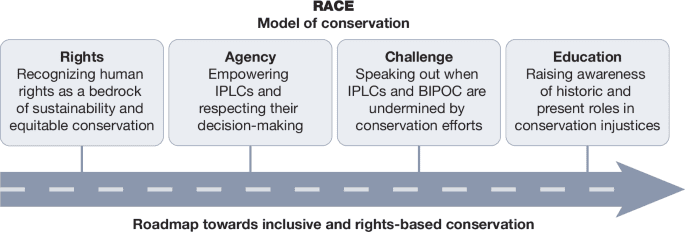
A framework for addressing racial and related inequities in conservation
Western, D., Wright, R. M. & Strum, S. C. (eds). Natural Connections: Perspectives in Community-Based Conservation (Island Press, 1994).
Jonas, H., Makagon, J. & Roe, D. in Conservation standards: From Rights to Responsibilities (International Institute for Environment and Development, 2016). Proposes a set of standards for conservation practice to uphold rather than violate the human rights of Indigenous peoples under international law.
Archer, L. J. et al. Towards fairer conservation: perspectives and ideas from early-career researchers. People Nat. 4, 612–626 (2022).
Google Scholar
Warren, T. & Baker, K. J. M. WWF funds guards who have tortured and killed people. Buzzfeed News https://www.buzzfeednews.com/article/tomwarren/wwf-world-wide-fund-nature-parks-torture-death (2019).
Weldemichel, T. G. Othering pastoralists, state violence, and the remaking of boundaries in Tanzania’s militarised wildlife conservation sector. Antipode 52, 1496–1518 (2020).
Google Scholar
Dhamoon, R. K. Relational othering: critiquing dominance, critiquing the margins. Polit. Groups Identities 9, 873–892 (2021).
Google Scholar
Kapoor, I. Hyper-self-reflexive development? Spivak on representing the Third World ‘Other. Third World Q. 25, 627–647 (2004).
Google Scholar
Rudd, L. F. Overcoming racism in the twin spheres of conservation science and practice. Proc. R. Soc. B 288, 20211871 (2021). This paper examines the systemic racism in conservation science and practice, reinforced by institutional structures and causing harm to BIPOC communities, and advances proposals to break this vicious cycle of racism.
Google Scholar
World Bank. Worldwide Governance Indicators. worldbank.org https://www.worldbank.org/en/publication/worldwide-governance-indicators (2023).
Carney, N. All lives matter, but so does race: Black Lives Matter and the evolving role of social media. Humanity Soc. 40, 180–199 (2016).
Google Scholar
Sarkar, S. Exorcising race and empire from American nature conservation. Bioscience 71, 777–779 (2021).
Google Scholar
Carroll, T. “It feels like white supremacy losing control”: gleaning local perspectives on “anti-woke” legislation. J. Race Ethn. Polit. 10, 603–631 (2025).
Google Scholar
Pailey, R. N. De-centring the ‘white gaze’ of development. Dev. Change 51, 729–745 (2020).
Google Scholar
Lartey, N. & Beauchamp, E. Discomfort to Discovery: Exploring Racism and Anti-Racism in Development Narratives (IIED, 2022).
Sapignoli, M. & Hitchcock, R. K. People, Parks, and Power: The Ethics of Conservation-Related Resettlement (Springer, 2023).
Adger, W. N., Kelly, P. M., Winkels, A., Luong, Q. H. & Locke, C. Migration, remittances, livelihood trajectories, and social resilience. Ambio 31, 358–366 (2002).
Google Scholar
Brockington, D. & Igoe, J. Eviction for conservation: a global overview. Conserv. Soc. 4, 424–470 (2006).
Peluso, N. L. & Lund, C. New frontiers of land control: Introduction. J. Peasant Stud. 38, 667–681 (2011).
Google Scholar
Mollett, S. & Kepe, T. Land Rights, Biodiversity Conservation and Justice: Rethinking Parks and People (Routledge, 2018).
Gurney, G. G., Adams, V. M., Álvarez-Romero, J. G. & Claudet, J. Area-based conservation: taking stock and looking ahead. One Earth 6, 98–104 (2023).
Google Scholar
Sandbrook, C. et al. Social considerations are crucial to success in implementing the 30 × 30 global conservation target. Nat. Ecol. Evol. 7, 784–785 (2023).
Google Scholar
Hammond, N. L., Dickman, A. & Biggs, D. Examining attention given to threats to elephant conservation on social media. Conserv. Sci. Pract. 4, e12785 (2022).
Google Scholar
Dickman, A., Cooney, R., Johnson, P. J., Louis, M. P. & Roe, D. Trophy hunting bans imperil biodiversity. Science 365, 874 (2019). This letter argues that trophy hunting bans could set back conservation in parts of Africa, as well-managed trophy hunting can finance conservation efforts and provide income to marginalized local communities.
Google Scholar
Barua, M. Whose issue? Representations of human–elephant conflict in Indian and international media. Sci. Commun. 32, 55–75 (2010).
Google Scholar
Martin, A., Mcguire, S. & Sullivan, S. Global environmental justice and biodiversity conservation. Geogr. J. 179, 122–131 (2013).
Google Scholar
Brockington, D. & Duffy, R. Capitalism and conservation: the production and reproduction of biodiversity conservation. Antipode 42, 469–484 (2010).
Google Scholar
WWF. Embedding Human Rights in Nature Conservation: From Intent to Action (World Wide Fund for Nature, 2023).
The Nature Conservancy. Human rights guide for working with Indigenous people and local communities. The Nature Conservancy https://www.tnchumanrightsguide.org/ (2024).
Jamieson, D. Global environmental justice. R. Instit. Philos. Suppl. 36, 199–210 (1994).
Google Scholar
Carpenter, C. Power in Conservation: Environmental Anthropology Beyond Political Ecology (Routledge, 2020). This book argues that an understanding of power through an anthropological lens—particularly a Foucauldian one—is essential to conservation theory and practice.
Büscher, B. & Fletcher, R. Towards convivial conservation. Conserv. Soc. 17, 283–296 (2019).
Google Scholar
Adams, W. M. & Hutton, J. People, parks and poverty political ecology and biodiversity conservation. Conserv. Soc. 5, 147–183 (2007).
Barton, G. A. Empire Forestry and the Origins of Environmentalism (Cambridge Univ. Press, 2002).
Cronon, W. Uncommon Ground: Rethinking the Human Place in Nature, Vol. 7 (W. W. Norton & Company, 1996).
Robin, L. & Griffiths, T. Environmental history in Australasia. Environ. Hist. 10, 439–474 (2004).
Google Scholar
Wolfe, P. Settler colonialism and the elimination of the native. J. Genocide Res. 8, 387–409 (2006).
Google Scholar
Grove, R. H. Green Imperialism: Colonial Expansion, Tropical Island Edens and the Origins of Environmentalism, 1600–1860 (Cambridge Univ. Press, 1995). This book traces the origins of modern environmentalism not to Western metropoles, but to the colonial peripheries, and argues that much of modern colonialism has its roots in colonial practices.
Crosby, A. W. Ecological Imperialism: The Biological Expansion of Europe, 900–1900 (Cambridge Univ. Press, 1986).
Carruthers, J. The Kruger National Park: A Social and Political History (Univ. of KwaZulu-Natal Press, 1995).
McGinn, P. Capital, ‘development’ and canal irrigation in colonial India. EconPapers https://econpapers.repec.org/paper/schwpaper/209.htm (2009).
Sweeney, S. Financing India’s Imperial Railways, 1875–1914 (Pickering & Chatto Ltd, 2011).
Rangarajan & Shahabuddin, G. Displacement and relocation from protected areas: towards a biological and historical synthesis. Conserv. Soc. 4, 359 (2006).
Baden-Powell, R. S. S. Pigsticking: Or, Hoghunting: A Complete Account for Sportsmen, and Others (Harrison and Sons, 1889).
Shanker, K. & Oommen, M. A. in A Functioning Anarchy? Essays for Ramachandra Guha (eds Raghavan, S. & Sundar, N.) 37–54 (Penguin Random House, 2021).
Büscher, B. ‘Rhino poaching is out of control!’ Violence, race and the politics of hysteria in online conservation. Environ. Plan. A 48, 979–998 (2015).
Google Scholar
Igoe, J. Conservation and Globalization: A Study of National Parks and Indigenous Communities from East Africa to South Dakota (Wadsworth, 2004).
McLean, J. & Stræde, S. Conservation, relocation, and the paradigms of park and people management — a case study of Padampur Villages and the Royal Chitwan National Park, Nepal. Soc. Nat. Resour. 16, 509–526 (2003).
Google Scholar
Neumann, R. Imposing Wilderness: Struggles Over Livelihoods and Nature Preservation in Africa (Univ. of California Press, 1998).
Brockington, D. Celebrity and the Environment: Fame, Wealth and Power in Conservation (Zed Books, 2009).
Adams, J. S. & McShane, T. O. The Myth of Wild Africa: Conservation Without Illusion (Univ. of California Press, 1997).
Büscher, B. et al. Half-Earth or whole Earth? Radical ideas for conservation, and their implications. Oryx 51, 407–410 (2017). This paper criticizes the ‘half-Earth’ proposal, arguing that it would require a massive increase in protected areas that would necessitate the mass displacement of mostly vulnerable human populations globally, perpetuating historic injustices.
Google Scholar
Tauli-Corpuz, V., Alcorn, J., Molnar, A., Healy, C. & Barrow, E. Cornered by PAs: adopting rights-based approaches to enable cost-effective conservation and climate action. World Dev. 130, 104923 (2020). This study traces how protected areas the world over come at the cost of and violate the rights of IPLCs, while their contribution in conserving nearly two billion hectares of land goes unrecognized.
Google Scholar
IPBES. Global assessment report on biodiversity and ecosystem services of the Intergovernmental Science-Policy Platform on Biodiversity and Ecosystem Services. Zenodo https://doi.org/10.5281/zenodo.3831674 (2019).
Garnett, S. T. et al. A spatial overview of the global importance of Indigenous lands for conservation. Nat. Sustain. 1, 369–374 (2018).
Google Scholar
Somanathan, E., Prabhakar, R. & Mehta, B. S. Decentralization for cost-effective conservation. Proc. Natl Acad. Sci. USA 106, 4143–4147 (2009).
Google Scholar
Domínguez, L. & Luoma, C. Decolonising conservation policy: how colonial land and conservation ideologies persist and perpetuate Indigenous injustices at the expense of the environment. Land 9, 65 (2020).
Google Scholar
CBD. Kunming–Montreal Global Biodiversity Framework. Convention on Biological Diversity https://www.cbd.int/gbf (2022).
Sibanda, L. et al. Avoiding an impending collision in international conservation. Conserv. Biol. 39, e14450 (2025).
Google Scholar
Duffy, R. et al. Why we must question the militarisation of conservation. Biol. Conserv. 232, 66–73 (2019).
Google Scholar
Bobo, L. & Tuan, M. Prejudice in Politics: Group Position, Public Opinion, and the Wisconsin Treaty Rights Dispute (Harvard Univ. Press, 2006).
Bobo, L. D. Racism in Trump’s America: reflections on culture, sociology, and the 2016 US presidential election. Br. J. Sociol. 68, S85–S104 (2017).
Google Scholar
Jardina, A. & Piston, S. The politics of racist dehumanization in the United States. Annu. Rev. Polit. Sci. 26, 369–388 (2023). This review examines the racist dehumanization of Black and Indigenous people in the USA, arguing that conventional white racial prejudice can be understood in part as the residue of processes of dehumanization.
Google Scholar
Kteily, N., Bruneau, E., Waytz, A. & Cotterill, S. The ascent of man: theoretical and empirical evidence for blatant dehumanization. J. Pers. Soc. Psychol. 109, 901–931 (2015).
Google Scholar
van Eeden, L. M. et al. Exploring nationality and social identity to explain attitudes toward conservation actions in the United States and Australia. Conserv. Biol. 34, 1165–1175 (2020).
Google Scholar
Mkono, M. Neo-colonialism and greed: Africans’ views on trophy hunting in social media. J. Sustain. Tour. 27, 689–704 (2019).
Google Scholar
Gardner, B. Elite discourses of conservation in Tanzania. Soc. Semiot. 27, 348–358 (2017).
Google Scholar
Jadhav, S. & Barua, M. The elephant vanishes: impact of human–elephant conflict on people’s wellbeing. Health Place 18, 1356–1365 (2012).
Google Scholar
Niskanen, L., Roe, D., Rowe, W., Dublin, H. & S. D. Strengthening Local Community Engagement in Combatting Illegal Wildlife Trade — Case Studies from Kenya (IIED, 2018).
Losh, J. Beloved silverback gorilla killed by poachers in Uganda. National Geographic https://www.nationalgeographic.com/animals/article/silverback-gorilla-killed-poachers-uganda (2020).
Goff, P. A., Eberhardt, J. L., Williams, M. J. & Jackson, M. C. Not yet human: implicit knowledge, historical dehumanization, and contemporary consequences. J. Pers. Soc. Psychol. 94, 292–306 (2008).
Google Scholar
Husain, Z. Demand to find tigress Avni’s cubs grows louder. The Hindu https://www.thehindu.com/news/cities/mumbai/demand-to-find-tigress-avnis-cubs-grows-louder/article25470378.ece (2018).
Macdonald, D., Jacobsen, K., Burnham, D., Johnson, P. & Loveridge, A. Cecil: a moment or a movement? Analysis of media coverage of the death of a lion, Panthera leo. Animals 6, 26 (2016).
Google Scholar
Gajanan, M. Cecil the lion’s death prompts calls to ban trophy hunt imports to US. The Guardian https://www.theguardian.com/world/2015/jul/28/cecil-african-lion-import-ban-trophy-hunting (2015).
Nzou, G. In Zimbabwe, we don’t cry for lions. The New York Times https://www.nytimes.com/2015/08/05/opinion/in-zimbabwe-we-dont-cry-for-lions.html (2015).
Cassim, J. Wild animals kill more people than COVID-19 in Zimbabwe. AA https://www.aa.com.tr/en/africa/wild-animals-kill-more-people-than-covid-19-in-zimbabwe/1860688 (2020).
O’Donnell, E., Poelina, A., Pelizzon, A. & Clark, C. Stop burying the lede: the essential role of Indigenous law(s) in creating rights of nature. Transnat. Environ. Law 9, 403–427 (2020). This paper argues that the rights of nature movement underplays the crucial role of Indigenous peoples in pushing the most transformative cases, and posits that such a movement can only be successful with Indigenous leadership.
Google Scholar
Gilbert, J. The rights of nature, Indigenous peoples and international human rights law: from dichotomies to synergies. J. Hum. Rights Environ. 13, 399–415 (2022).
Newing, H. et al. ‘Participatory’ conservation research involving indigenous peoples and local communities: fourteen principles for good practice. Biol. Conserv. 296, 110708 (2024).
Google Scholar
UNEP. Core Human Rights Principles for Private Conservation Organizations and Funders (United Nations Environment Programme, 2024).
World Conservation Society. Conservation and Human Rights: A Framework for Action (World Conservation Society, 2009).
Norfolk, S., Quan, J. & Mullins, D. Options for Securing Tenure and Documenting Land Rights in Mozambique: A Land Policy & Practise Paper (LEGEND, 2022).
Rahmatiar, Y. Legal protection and rights of Indigenous peoples: legal certainty in managing natural resources. Pena Justisia 22, 1485–1505 (2023).
Springer, J., Campese, J. & Painter, M. Conservation and Human Rights: Key Issues and Contexts Scoping Paper for the Conservation Initiative on Human Rights (IUCN, 2011).
Sarma, U. K. & Barpujari, I. Coexistence and the SDGs: an argument for a rights-based approach to human–wildlife conflict in India. Hum. Dimens. Wildl. 30, 248–256 (2025).
Google Scholar
Newing, H., Fisher, M., Brittain, S., Kenrick, J. & Milner-Gulland, E. J. How can we advance equitable, rights-based conservation?. Oryx 57, 273–274 (2023).
Google Scholar
Tauli-Corpuz, V., Alcorn, J., Molnar, A., Healy, C. & Barrow, E. Cornered by PAs: adopting rights-based approaches to enable cost-effective conservation and climate action. World Dev. 130, 104923 (2020).
Google Scholar
Wiessner, S. The cultural rights of Indigenous peoples:achievements and continuing challenges. Eur. J. Int. Law 22, 121–140 (2011).
Google Scholar
Challender, D. W. S., Harrop, S. R. & MacMillan, D. C. Towards informed and multi-faceted wildlife trade interventions. Glob. Ecol. Conserv. 3, 129–148 (2015).
Rosencranz, A. et al. The Forest Rights Act 2006: high aspirations, low realization. J. Indian Law Inst. 50, 656–677 (2008).
Kumar, K., Singh, N. & Rao, Y. G. Promise and performance of the Forest Rights Act. Econ. Polit. 52, 40–43 (2017).
Minter, T., de Brabander, V., van der Ploeg, J., Persoon, G. A. & Sunderland, T. Whose consent? Hunter-gatherers and extractive industries in the northeastern Philippines. Soc. Nat. Resour. 25, 1241–1257 (2012).
Google Scholar
Greiber, T., Janki, M., Orellana, M., Savaresi, A. & Shelton, D. L. Conservation with justice: a rights-based approach. SSRN https://doi.org/10.2139/SSRN.2225952 (2010).
Lee, R. B. in At the Risk of Being Heard: Identity, Indigenous Rights, and Postcolonial States (eds Dean, B. & Levi, Jerome. M.) 80–111 (Univ. of Michigan Press, 2003).
Johnson, A. in The Fire Now: Anti-Racist Scholarship in Times of Explicit Racial Violence (eds Johnson, A., Joseph-Salisbury, R. & Kamunge, B.) 15–25 (Zedbooks, 2018).
Muller, S., Hemming, S. & Rigney, D. Indigenous sovereignties: relational ontologies and environmental management. Geogr. Res. 57, 399–410 (2019).
Google Scholar
Biggs, D. et al. Breaking the deadlock on ivory. Science 358, 1378–1381 (2017).
Google Scholar
Natusch, D. J. D., Aust, P. W. & Shine, R. The perils of flawed science in wildlife trade literature. Conserv. Biol. 35, 1396–1404 (2021).
Google Scholar
Kansky, R., Kidd, M. & Knight, A. T. A wildlife tolerance model and case study for understanding human wildlife conflicts. Biol. Conserv. 201, 137–145 (2022).
Google Scholar
Madden, F. & McQuinn, B. Conservation’s blind spot: the case for conflict transformation in wildlife conservation. Biol. Conserv. 178, 97–106 (2014).
Google Scholar
Lynch, A. J. J., Fell, D. G. & McIntyre-Tamwoy, S. Incorporating Indigenous values with ‘Western’ conservation values in sustainable biodiversity management. Australas. J. Environ. Manag. 17, 244–255 (2010). This paper studies the difference in priorities and outlook between Indigenous cultural values and Western conservation values, and argues for a more participatory model.
Google Scholar
Newing, H. & Perram, A. What do you know about conservation and human rights?. ORYX 53, 595–596 (2019).
Google Scholar
Oviedo, G. et al. Conservation and Human Rights: The Need for International Standards (IIED, 2010).
Montgomery, R. A., Borona, K., Kasozi, H., Mudumba, T. & Ogada, M. Positioning human heritage at the center of conservation practice. Conserv. Biol. 34, 1122 (2020).
Google Scholar
Fraser, N. & Honneth, A. Redistribution or Recognition? — A Political–Philosophical Exchange (Verso, 2003).
Adams, W. M. et al. Biodiversity conservation and the eradication of poverty. Science 306, 1146–1149 (2004).
Google Scholar
Wells, M., Brandon, K. & Hannah, L. People and Parks: Linking Protected Area Management with Local Communities (World Bank, 1992).
CBD. Article 8(j) — Traditional Knowledge, Innovations and Practices (Convention on Biological Diversity, 2025).
CBD. Article 10 — Sustainable Use of Components of Biological Diversity (Convention on Biological Diversity, 2006).
Gadgil, M., Berkes, F. & Folke, C. Indigenous knowledge for biodiversity conservation. Ambio 22, 151–156 (1993).
Schroeder, H. & González, P. N. C. Bridging knowledge divides: the case of indigenous ontologies of territoriality and REDD. For. Policy Econ.100, 198–206 (2020).
Google Scholar
Northwest Indian Fisheries Commission. Annual report. nwifc.org https://nwifc.org/publications/annual-report/ (2020).
Artelle, K. A. et al. Values-led management: the guidance of place-based values in environmental relationships of the past, present, and future. Ecol. Soc. 23, 35 (2018). This synthesis argues that place-based values, held by communities with long historical ties to the place, can guide more effective environmental frameworks than the values of conservationists coming in from the outside.
Google Scholar
McElwee, P. et al. Working with Indigenous and local knowledge (ILK) in large-scale ecological assessments: reviewing the experience of the IPBES Global Assessment. J. Appl. Ecol. 57, 1666–1676 (2020).
Google Scholar
Reo, N. J. Inawendiwin and relational accountability in Anishnaabeg studies: the crux of the biscuit. J. Ethnobiol. 39, 65 (2019).
Google Scholar
Blake, E. Tribal co-management: a monumental undertaking? Ecol. Law Q. 48, 249 (2021).
Schroeder, D., Chennells, R., Louw, C., Snyders, L. & Hodges, T. The Rooibos Benefit Sharing Agreement—breaking new ground with respect, honesty, fairness, and care. Camb. Q. Healthc. Ethics 29, 285–301 (2020).
Google Scholar
Davis, J. M. & Swiss, L. Need, merit, self-interest or convenience? Exploring aid allocation motives of grassroots international NGOs. J. Int. Dev. 32, 1324–1345 (2020).
Google Scholar
Phelps, J., Webb, E. L. & Agrawal, A. Does REDD + threaten to recentralize forest governance?. Science 328, 312–313 (2010).
Google Scholar
Osborne, T. et al. Climate justice, forests, and Indigenous peoples: toward an alternative to REDD+ for the Amazon. Clim. Change 177, 128 (2024).
Google Scholar
Biggs, D. et al. Insights on fostering the emergence of robust conservation actions from Zimbabwe’s CAMPFIRE program. Glob. Ecol. Conserv. 17, e00538 (2019).
Chaudhury, A. & Colla, S. Next steps in dismantling discrimination: Lessons from ecology and conservation science. Conserv. Lett. 14, e12774 (2021).
Google Scholar
Pienkowski, T. et al. Recognizing reflexivity among conservation practitioners. Conserv. Biol. 37, e14022 (2023).
Google Scholar
Beck, J. M., Elliott, K. C., Booher, C. R., Renn, K. A. & Montgomery, R. A. The application of reflexivity for conservation science. Biol. Conserv. 262, 109322 (2021).
Google Scholar
Cronin, M. R. et al. Anti-racist interventions to transform ecology, evolution and conservation biology departments. Nat. Ecol. Evol. 5, 1213–1223 (2021). This perspective provides a practical toolkit of evidence-based interventions that departments in ecology, evolution, and conservation biology can adopt to foster anti-racism, not just in terms of diversity, but also practice in the field.
Google Scholar
Hà, B. A., Foxx, K., Mensah, S. T., Barber, P. H. & Kennison, R. L. Interdisciplinary approaches to advancing anti-racist pedagogies in ecology, evolution, and conservation biology. Trends Ecol. Evol. 38, 683–687 (2023).
Google Scholar
Ziltener, P., Künzler, D. & Walter, A. Measuring the impacts of colonialism: a new data set for the countries of Africa and Asia. J. World Syst. Res. 23, 156–190 (2017).
Google Scholar
Ochoa-Ochoa, L. M., Devillamagallón, R., Castillo-Ramírez, G. & Cordero-Marines, L. Effects of Atlanticists policies and visions: the legacy of colonialism in conservation. Biol. Conserv. 282, 110070 (2023).
Google Scholar
Cooke, S. J. et al. Reconceptualizing conservation. PLOS Sustain. Transform. 1, e0000016 (2022).
Google Scholar
Ocampo-Ariza, C. et al. Global south leadership towards inclusive tropical ecology and conservation. Perspect. Ecol. Conserv. 21, 17–24 (2023).
Whyte, K. P. On the role of traditional ecological knowledge as a collaborative concept: a philosophical study. Ecol. Process. 2, 7 (2013).
Google Scholar
Gillette, M., Shebitz, D. & Singleton, B. Doing conservation differently: toward a diverse conservations inventory. Ethnobiol. Lett. 14, 1–9 (2023).
Google Scholar
Child, B. & Jones, B. Overview Article: Practical Tools for Community Conservation in Southern Africa (PLA 55) (IIED, 2006).
Greenwood, D. J., Whyte, W. F. & Harkavy, I. Participatory action research as a process and as a goal. Hum. Relat. 46, 175–192 (1993).
Google Scholar
Smith, L. T. Decolonizing Methodologies: Research and Indigenous Peoples (Zed Books, 2021).
Nicholls, R. Research and Indigenous participation: critical reflexive methods. Int. J. Soc. Res. Methodol. 12, 117–126 (2009).
Google Scholar
Louis, R. P. Can you hear us now? Voices from the margin: using Indigenous methodologies in geographic research. Geogr. Res. 45, 130–139 (2007).
Google Scholar
Grossman, Z. et al. AAG Indigenous Peoples Specialty Group’s Declaration of Key Questions about Research Ethics with Indigenous Communities (Indigenous Peoples’ Secretariat, 2010). This statement poses a set of reflective questions that researchers should ask themselves when engaging in research involving Indigenous communities, to ensure that Indigenous peoples will be rights-bearing partners rather than merely subjects.
Dunaway, M., Allred, S., Somchanhmavong, A. K. & Zaman, T. A pragmatic approach to ethical research collaboration with Indigenous communities: a case study with the Penan people of Long Lamai, Malaysia. Environ. Plann. F 2, 77–95 (2023). This case study on the application of the Association of American Geographers Indigenous Peoples Specialty Group declaration discusses how all its key elements can be implemented in practice, using examples from the Global Citizenship and Sustainability programme in Long Lamai, Malaysia.
Google Scholar
McCrummen, S. The great Serengeti land grab. The Atlantic https://www.theatlantic.com/magazine/archive/2024/05/maasai-tribe-tanzania-forced-land-evictions-serengeti/677835/ (2024).
Presnall, C. C. Wildlife conservation as affected by American Indian and Caucasian concepts. J. Mammal. 24, 458 (1943).
Google Scholar
Peters, M. A. & Mika, C. T. Aborigine, Indian, indigenous or first nations? Educ. Phil. Theory 49, 1229–1234 (2017).
Google Scholar
UN. United Nations Expert Mechanism on the Rights of Indigenous Peoples (United Nations, 2023).
Holmes, G. The rich, the powerful and the endangered: conservation elites, networks and the Dominican Republic. Antipode 42, 624–646 (2010).
Google Scholar
Chomba, S. Choices have consequences: REDD+ and local democracy in Kenya. Conserv. Society 15, 400–413 (2017).
Google Scholar
Mrema, J. P. in Corruption, Natural Resources and Development (eds Williams, A. & Le Billon, P.) 131–141 (Edward Elgar Publishing, 2017).
Logan, B. I. & Moseley, W. G. The political ecology of poverty alleviation in Zimbabwe’s Communal Areas Management Programme for Indigenous Resources (CAMPFIRE). Geoforum 33, 1–14 (2002).
Google Scholar
■ مصدر الخبر الأصلي
نشر لأول مرة على: www.nature.com
تاريخ النشر: 2026-01-07 02:00:00
الكاتب: Moreangels M. Mbizah
تنويه من موقع “yalebnan.org”:
تم جلب هذا المحتوى بشكل آلي من المصدر:
www.nature.com
بتاريخ: 2026-01-07 02:00:00.
الآراء والمعلومات الواردة في هذا المقال لا تعبر بالضرورة عن رأي موقع “yalebnan.org”، والمسؤولية الكاملة تقع على عاتق المصدر الأصلي.
ملاحظة: قد يتم استخدام الترجمة الآلية في بعض الأحيان لتوفير هذا المحتوى.